NATO (STO)
Winning over 60 senior managers facing an organisational restructuring
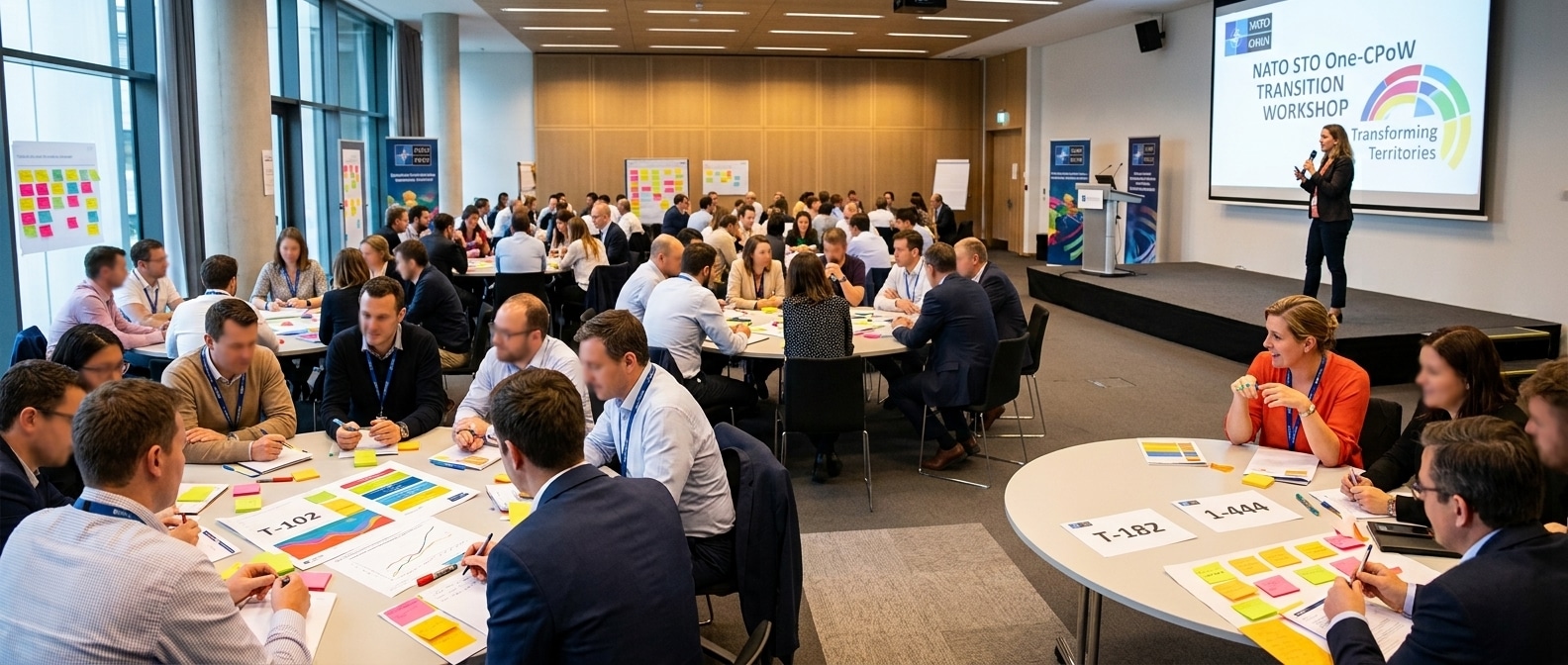
When an international organisation embarks on a major transformation project , simply cascading directives from the top usually runs into deeply ingrained habits. To makechange management work within NATO’s Science & Technology Organization (STO), Arcane Experience designed a bespoke gamified workshop. The aim: anticipate resistance to change, put the human factor at the heart of the programme and build genuine change momentum shared by every key stakeholder.
The challenge: easing fears of red tape and breaking down silos
To adapt its structure to new innovation and security demands, NATO STO had to drive change globally by rolling out its unified model (One-CPoW). But for scientific committees used to a high degree of autonomy, this organisational change raised concerns: duplicated admin, heavier processes and a loss of agility. For the leadership team, the core change management challenge was to steer the change in a participative way and win buy-in from the teams, without imposing rigid constraints.
Our answer: two months of co-creation for a game-based facilitation workshop
To deliver support that meets the standards of demanding organisations , Arcane Experience built a five-stage learning game design. Over two months, our teams worked with the coordination office to define the change strategy and turn dense regulatory texts into a stimulating workshop. This change managementprogramme, run by our specialists and on-site facilitators, was designed to support managers and their secretariats through this decisive transition.
How the game works: five phases to make change stick

Tactical grounding through challenge (Battleships under constraints)
An immersive tactical simulation played under strict sensory and communication constraints (players blind, mute or unable to move). The exercise shows that even the best individual intentions fall flat without a shared language. It makes clear that successful organisational transformation calls for rigorous harmonisation of practices.

Dismantling barriers through inversion (The Saboteur role play)
A participative reverse-psychology workshop combining sabotage phases and antidotes. By inviting managers to dream up the worst possible red tape, then design the counter-measures to overcome resistance, teams become ambassadors for simplification and co-write their own charter.

Strategic alignment through friendly rivalry (CPoW Arena interactive quiz)
A competitive interactive quiz of 33 questions to master the new governance model. This high-intensity format helps people absorb the regulatory texts and key vocabulary far faster. It gives every employee a clear grasp of what the unified model involves and aims to achieve.

Role-specific ownership through peer learning (Targeted Survival Guide)
A facilitated session in sub-groups formed by role (Executive Officers and Assistants). This focused reflection exercise brings team support as close as possible to day-to-day reality. It translates global policy into three operational reflexes that secure organisational change on a daily basis.

Cross-functional delivery through action (One-CPoW collaborative canvas)
A hands-on co-creation case study on a game board, mapping the workflow of a multi-committee AI project. This concrete scenario leads participants to structure decision-making around three key pillars. It activates the real levers of change that deliver lasting cross-functional efficiency.
Impact and benefits: from apprehension to operational commitment
Collective realisation
A solid change culture takes root and psychological barriers come down.
Strategic feedback from the field
Simplification rules drafted by employees themselves to protect their working time.
Dialogue restored
Immediate operational reconnection between support teams and senior managers.
FAQ: Gamified workshops & change management
Why choose a gamified workshop for a complex change management programme?
In a restructuring, resistance to change is mainly emotional and cultural. A gamified workshop creates a safe space — a sandbox — where people speak freely, voice their fears without conflict and shift from passive employees to co-authors of the transformation.
How does gamification defuse the fear of red tape?
Using reverse-psychology mechanics such as the saboteur game, the format lets participants express their worst fears in a playful way. Tensions drop, and the group moves straight on to co-writing pragmatic simplification rules.
Do gamified workshops suit institutions and sovereign environments?
Absolutely. International organisations and defence bodies operate within strict regulatory frameworks. As shown in our project for the European Commission, gamification never waters down the content: it relies on rigorous learning game design that respects the institution’s culture while adding the interactivity needed to support transformation.
